



| JEEPINE Rotary Cap Compression Machine Rotary CCM machine for continuous plastic bottle cap molding · 24 to 64 cavities Continuous turntable compression · PP / PE / HDPE · 24,000 – 150,000 caps per hour |

| How the Rotary Compression Principle Works |
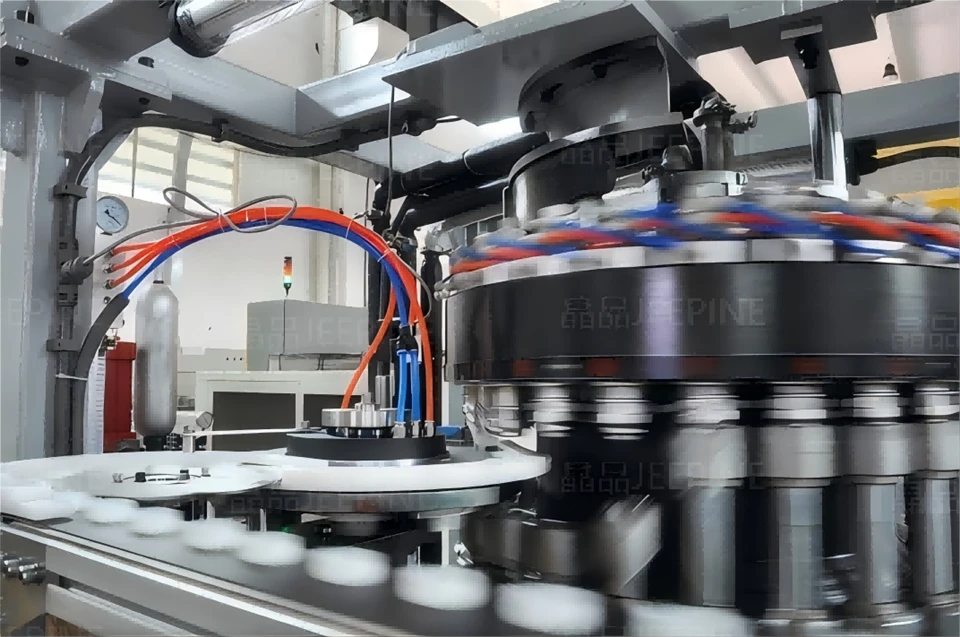
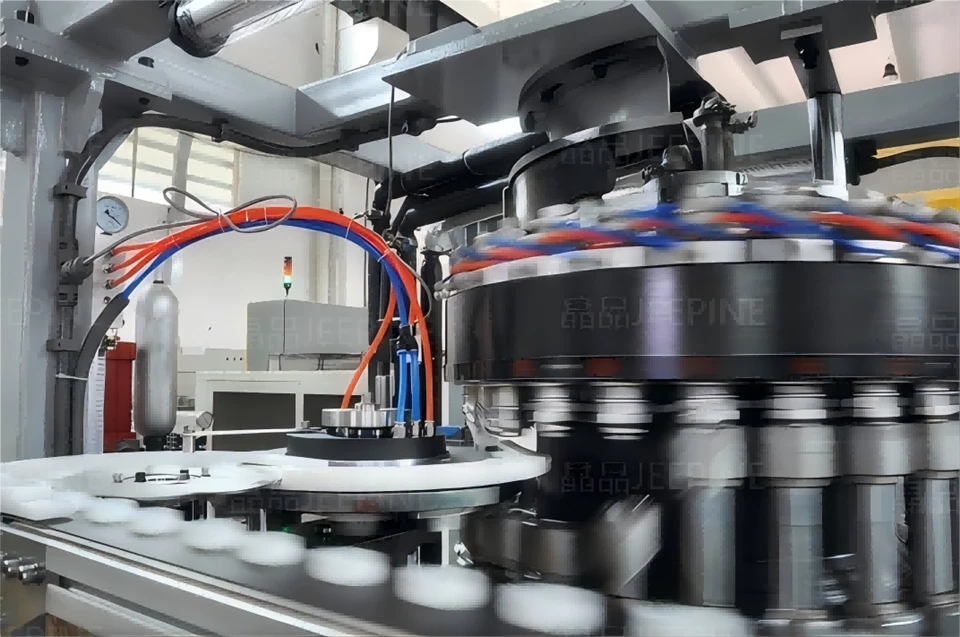
A rotary cap compression machine forms caps on a horizontal rotating turntable that carries a ring of mold cavities around the machine. As the table turns, every cavity passes through the same sequence of stations in one continuous cycle: a measured resin pellet drops into the cavity, the mold closes, the pellet is compressed into cap shape, the part cools under pressure, and the finished cap is lifted out by vacuum before the empty cavity returns to the dosing station. Because forming, cooling and ejection happen in parallel on different cavities, the rotary compression molding machine keeps a high, steady output instead of waiting for one mold to finish before the next starts.

| Stations on the Rotary Cycle |
| Station 1 · Pellet Dosing | Low-temperature melt is extruded and cut into equal-weight pellets; a dosing feeder places one pellet into each cavity as it passes. |
| Station 2 · Mold Closing | The upper and lower mold halves close with low-pressure contact; PID closed-loop control keeps clamping force even across the whole turntable. |
| Station 3 · Compression Forming | The pellet is pressed into the cap geometry inside the cavity. No gate or runner is involved, so the cap surface forms directly against the mold finish. |
| Station 4 · Cooling | Cooling channels in the mold hold the part at controlled temperature until dimensions stabilize and shrinkage is minimized. |
| Station 5 · Vacuum Ejection | Vacuum adsorption lifts the finished cap out of the cavity without mechanical contact, then transfers it to the downstream conveyor. |
| Rotary Compression Compared With Injection Molding |
| Point of Comparison | JEEPINE Rotary CCM | Conventional Injection Molding |
| Forming action | Parallel stations on a rotating table; continuous multi-cavity cycle. | Shot-by-shot injection; each mold cycle waits for screw plasticizing and filling. |
| Material waste | No runner or sprue; resin utilization close to 100%. | Runner and sprue material must be reground and reprocessed. |
| Cap surface | No gate mark; smooth mold finish ready for printing and lining. | Gate mark remains on the closure surface. |
| Internal stress | Low stress, minimal shrinkage, tight dimensional tolerance. | Higher residual stress and greater shrinkage variation. |
| Energy load | Low-temperature melting; lower heating and cooling demand. | Higher melt temperature and larger cooling load. |
| Rotary Machine Range by Cavity Count |
| Model | Rotary Cavities | Max Output | Max Cap OD | Max Weight | Installed Power |
|---|---|---|---|---|---|
| CCM-JP24 | 24 | 24,000 pcs/h | Φ55 mm | 7.5 g | 65 ±5 kWh |
| CCM-YSZG24 | 24 | 40,000 pcs/h | Φ55 mm | 7.5 g | 83 ±5 kWh |
| CCM-YSZG48A | 48 | 80,000 pcs/h | Φ35 mm | 4 g | 116 ±5 kWh |
| CCM-YSZG48B | 48 | 75,000 pcs/h | Φ45 mm | 6.5 g | 116 ±5 kWh |
| CCM-YSZG54 | 54 | 100,000 pcs/h | Φ35 mm | 4 g | 122 ±5 kWh |
| CCM-YSZG64 | 64 | 150,000 pcs/h | Φ45 mm | 4 g | 150 ±5 kWh |
Resin: PP / PE / HDPE · Output figures are reference values for standard water caps; final capacity depends on cap structure, weight and ambient conditions · Yield rate ≥ 99.5% under standard operation.

| Molds, Resins and Weight Control |
| Self-Developed Molds | Precision wear-resistant molds are designed and machined in-house, matched to the neck finish, thread, tamper band and liner groove of each cap design. |
| Compatible Resins | PP, PE and HDPE. HDPE is typically used for flexible tamper bands on carbonated beverage caps; PP is common for water and hot-fill closures. |
| Stable Gram Weight | Dosing pellets are cut to a fixed weight and distributed evenly across cavities, so cap weight and wall thickness stay consistent between cycles and shifts. |
| Fast Changeover | Mold and color change are simplified for cap makers who run multiple SKUs; spare parts are standardized for local maintenance. |

| Quality Consistency on the Rotary Table |
The rigid turntable and hydraulic clamping structure keep every cavity on the same plane, so parts molded at the start, middle and end of a shift share the same dimension and sealing performance. A PLC system monitors temperature, clamping and output in real time, with automatic fault alarm and self-diagnosis. Vacuum ejection removes caps without contact, avoiding scratches and indentations, and an optional online vision station removes deformed, stained or short-shot pieces before packing.
| Optional Line Modules |
| · Centralized feeding | · Mold temperature control | · Cap cooling system | · Cap sorting machine |
| · Slitting & folding | · Cap printing machine | · Laser coding machine | · Online vision inspection |
| · Liner lamination | · Auto packing machine | · Custom mold design | · Turnkey line layout |
| Typical Closures Produced |
Water caps (2622, 2722, 2925, 3025, 1810), carbonated soft drink caps (2622 CSD, 1881 CSD), café and fruit drink caps (CAF), hot-fill caps, dairy and aseptic closures, 38 mm smart and combination caps, 48 mm and 55 mm smart caps, liquor inner caps, toothpaste and daily chemical caps, medical caps and custom tamper-evident closures.

| JEEPINE Manufacturing Background |
| 2008 CCM machine manufacturing since |
35+ Countries served |
700+ Rotary CCM machines in service |
130+ Technical patents |
JEEPINE designs and builds machines and molds in-house rather than trading others' equipment. The rotary cap compression machine lineup is CE certified and installed across water, beverage, dairy, food, personal care and pharmaceutical packaging plants in Southeast Asia, Africa, the Middle East and the Americas.

| Common Questions on Rotary CCM Machines |
| Q: What does "rotary" refer to in a cap compression machine? A: It describes the rotating turntable that carries all mold cavities around the machine. Dosing, closing, compression, cooling and ejection happen at separate stations while the table turns, allowing continuous parallel forming. |
| Q: How many cavities can the rotary table carry? A: JEEPINE builds 24, 48, 54 and 64-cavity configurations, from 24,000 up to 150,000 caps per hour, matched to your daily output and cap size. |
| Q: How is cap weight kept the same across all cavities? A: Pellets are cut to a fixed weight before dosing, the rigid turntable keeps clamping even, and mold temperature control stabilizes the cycle. The PLC monitors the process continuously and alarms on deviation. |
| Q: Can one machine switch between different cap sizes? A: Yes, by changing the mold set. JEEPINE supplies custom molds for different neck finishes, threads, tamper bands and liner grooves, and the color changeover is designed to be fast for multi-SKU plants. |
| Q: Is the rotary machine fully automatic? A: The CCM host runs automatically under PLC control. It can be delivered as a standalone machine or integrated with feeding, sorting, printing, coding, inspection and packing modules into one turnkey line. |
| Request Rotary Machine Specifications and Quote Tell us your cap type, neck finish, target output and factory conditions; JEEPINE engineers reply with cavity selection, mold design and line layout. Email: sales@jeepine.com.cn Tel: +86 18820532054 Whatsapp: +86 18170870137 Address: Room 101, Building 4 & Building 5, No. 23, Yunpu 1st Road, Huangpu District, Guangzhou, China |
JEEPINE · Rotary Cap Compression Machine Manufacturer · Guangzhou, China · Content updated November 2026
Guangzhou Jeepine Intelligent Compression Molding Machine Co., Ltd. is one of the leading manufacturers and suppliers of jeepine rotary cap compression machine in China. We have world-leading production equipment and strong manufacturing capabilities. Please rest assured to buy customized jeepine rotary cap compression machine at competitive price from our factory.
Hot Tags: jeepine rotary cap compression machine, China, manufacturers, suppliers, factory, customized